
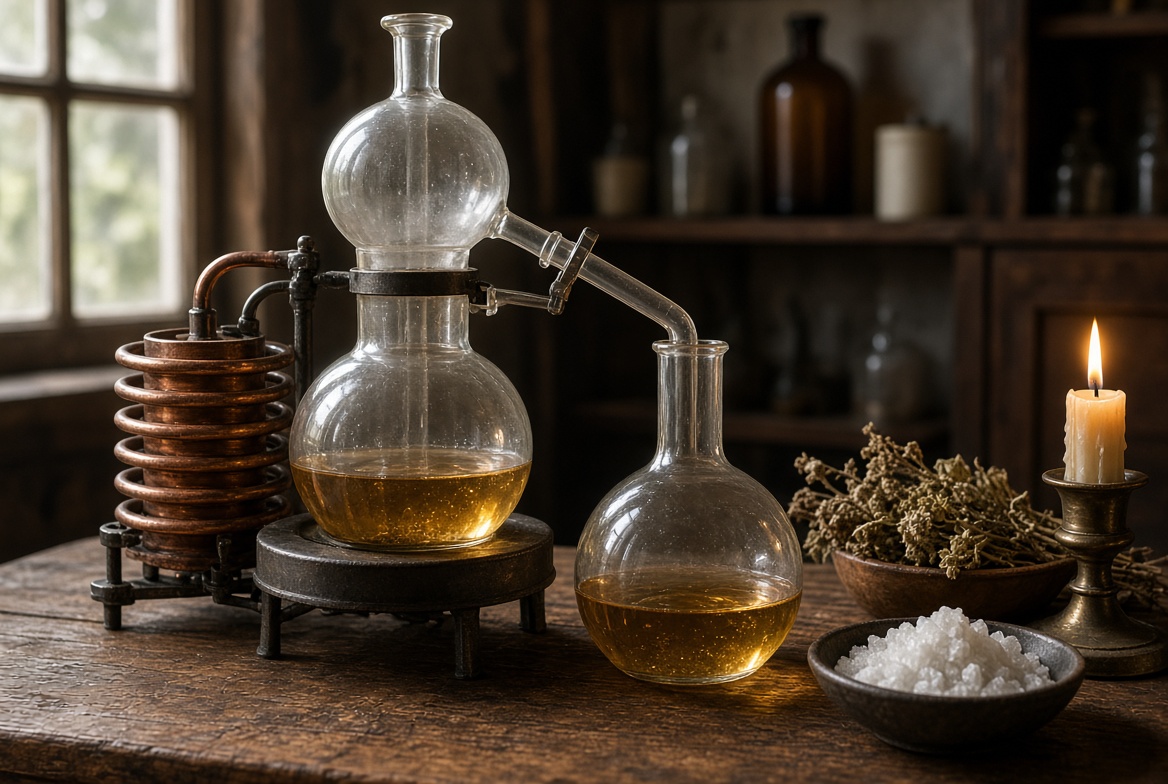
What a spagyric actually is
Most bottles labeled “spagyric” are alcoholic extracts with a story attached. The word is older and stricter than that. Spao — to draw out. Ageiro — to gather. You separate the plant into its three philosophical principles, purify each, and put them back together so the medicine has spirit, soul, and body.
In the lab that looks like this: extract the volatiles and the alcohol-soluble fraction. Burn the remaining plant body to ash. Extract the water-soluble mineral salts from that ash, often through cycles of dissolution and crystallization. Return those salts to the extract and digest until the preparation is one thing again.
Why the salts matter
A tincture without its salts is a ghost. It may smell correct. It may even shift a tissue state for an hour. It does not have the mineral skeleton that tells the body where to file the information. This is why Aurelian work spends so much time on calcination and on the quality of the starting biomass. Wild, biodynamic, or regeneratively grown plants already carry a different salt profile than a commodity herb that grew in sterile medium.
I do not pretend every kitchen can run a full philosophic essence. I do pretend that if you are going to invoke alchemy you should know whether the bottle in your hand contains the plant’s body.
Tissue states, not ingredient lists
Matthew Wood’s six tissue states — hot, cold, dry, damp, tense, lax — are how I decide which plant, not how I decorate a formula. A person can be dry and tense in the gut and damp and lax in the mucosa. Chamomile is not “for anxiety.” It is a particular answer to a particular pattern. Timing the work to a true sidereal election is optional seasoning. The pattern reading is not.
If you take one thing from this note: ask your herbalist whether the salts came home. If they look at you blankly, you have a tincture. That can still be useful. It is not the same craft.